


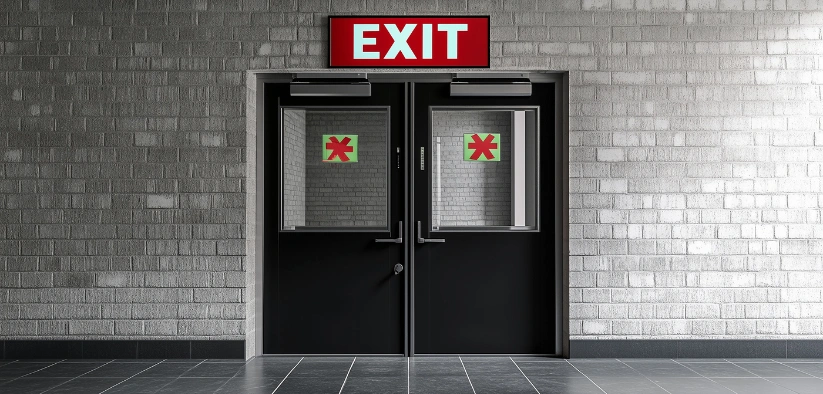
Fire exit doors are not a mere building element regarding fire, but they save lives. These doors are important in case of an emergency when people need to get out of the place in the shortest possible time. However, in construction or renovation work, when fire exit doors need to be chosen, the choice is made in a rush or as a formality.
Having observed the close collaboration with safety consultants, architects, and facility managers, we have learnt that even minor errors in the selection of fire exit doors may result in a severe safety hazard, legal complications, and expensive replenishment in the future. In order to make the right decision, our team has compiled this handy guide with the most popular pitfalls to avoid in the process of selecting fire exit doors and how to do it the first time.
Let's dive into the blog to know what the common mistakes are to avoid when selecting a fire exit door and how the reliable fire exit door manufacturers in Chennai provide high safety doors.
One of the biggest mistakes people make is choosing fire exit doors without checking them properly. The fire exit door with the certifications provides long-term durability and performance. The certified fire exit doors are tested under controlled conditions to ensure they can withstand fire for a specific duration of up to 30, 60, 90 or 120 minutes. When standards such as IS, BS, or UL certifications are ignored, the door may fail during an actual fire.
We recommend that, before choosing a fire exit door, it should meet the international fire safety standard regulations. The certified documents are essential for the premium-grade fire exit doors.
Everyone knows budget is the main concern, but also compromising safety for a lower price is a dangerous move. That's why choosing a reliable fire exit door manufacturer that provides the doors at reasonable prices without compromising the premium standard is important. Choosing the fire exit door without evaluating material quality, hardware, or fire rating may cause a huge impact on safety.
The smart approach to purchasing fire exit doors is to put in a safety investment, without compromising the quality. A reliable door protects lives, property and your reputation. Spending a little more upfront often prevents expensive replacements, non-compliance issues, and most importantly, safety risks later.
Do you know? Not every fire exit door is designed for every environment; that's why selecting doors suitable for your building for the safety performances is important. A common mistake is choosing a standard door design without considering the building usages, occupancy type and risk level. Before selecting a fire exit door, understand your building's need for better protection.
A door installed in the wrong environment can corrode, malfunction or become difficult to operate during emergencies. That's why selecting the right fire exit door is essential.
Understand your building to evaluate where and how the door will be used before finalising the model. The right fire exit door should match the building's functional demands and provide complete protection.
Hardware plays an equally important role, as it performs fire exit doors. As a matter of fact, the performance of elements like panic bars, door closers, hinges, and locks is very important in an emergency. Poor-quality hardware may lead to doors sticking together or closing slowly and they might not latch. Even a small malfunction will result in panic, overcrowding, or harm in high-stress situations. In our experience, fire exit doors must always be provided as a complete system, a tested system, with the hardware being compatible and purposely designed to be used for fire-rated purposes.
Before choosing a fire exit door, choose doors with tested compatible hardware designed specifically for fire safety applications. The high-quality fire exit doors provide maximum safety in emergency situations.
Also Read This: Why Fire Exit Doors Are a Must-Have for Workplace Safety
The second error that is common is the use of inappropriate dimensions and swing direction on fire exit doors. This usually occurs when the planning of doors is not done in haste or when it is not checked with fire safety standards. The narrowness of doors may also limit the flow of evacuations, particularly when it comes to high-occupancy buildings. In the same manner, inward-opening doors may act as a barrier to escape when there are many people toward the door in emergencies. Proper sizing not only ensures that one complies but also avoids bottlenecks in moments of dire need.
Fire exit doors should be well dimensioned in terms of occupancy load so that evacuation in the event of fire is smooth and unhindered. Enlarged door openings would assist in avoiding congestion and speeding movement, particularly in structures that are very busy, like malls, hospitals, schools, and complexes.
In the fire exit door, the ease of operation is one of the most overlooked aspects of fire exit door selection. In emergency situations, people are panicked, injured or unfamiliar with the building layouts, which is why the ease of access to the fire exit doors without the complex locking systems or stiff handles makes the exit quick and possible.
The fire exit door should provide fast, quick access and be effortless to operate in emergency situations. Panic bars and push mechanisms should allow instant opening with minimal force, ensuring accessibility for all age groups.
Even the best fire exit door may fail when installed incorrectly. Among the errors that have been made is the tendency to take installation as a normal carpentry job and not as a safety exercise. Poorly fitting frames, wrong tolerances of gaps, omission of fire-rated sealants, or badly attached fittings can all weaken the fire resistance. There are situations when doors that seem good to the eye do not pass examination because of the mistakes in the installation. Selecting a professional fire exit door designer, it offers an excellent backing for the installation, which creates a correct safeguard.
We highly stress that, however well done the fire exit door is, it can also fail in case it is incorrectly installed. Installation is not an ordinary carpentry operation but rather a safety requirement work which has a direct influence on the fire resistance, sealing and ease of use of the door.
Most of the owners of buildings believe that fire exit doors would be operational indefinitely without any form of maintenance. This presumption may be risky. Hinges, closers, panic bars, and seals may wear out and tear with time. Small problems are not spotted without routine maintenance, and the door breaks at the time when the customer needs it the most. There have been instances where doors are found ineffective during audits due to blocked exits, broken closers or broken seals.
With time, frequent usage, environmental factors and wear may interfere with or damage important elements like hinges, door closers, panic bars and locks, as well as smoke seals. We suggest that a regular check-up and testing schedule be created so that the door opens smoothly, closes completely, and the lock always works during each instance.
Decision-making on fire exit doors is one of the largest errors that are made without involving qualified personnel. The trained professionals in fire safety and qualified manufacturers can provide a good contribution to compliance, design and performance. In the case of isolated decision-making, projects tend to experience last-minute changes or delays in approving the project or even rework at an expensive cost. Even beforehand, planning to prevent mistakes and making sure that the chosen doors are both required by the regulations and practical.
Do you know? Fire exit doors are mute guardians in emergency cases. The lack of awareness, hasty decisions, or cost compromises are the primary causes of most errors in choosing fire exit door manufacturers in Chennai. We believe that every fire exit door must function flawlessly when it is most needed. With the help of the above-mentioned mistakes, you can avoid making them and cooperate with skilled and certified specialists to guarantee that your building not only conforms to the requirements but is also really safe.